Comparisons
OpenClaw vs LangChain: AI Agent Frameworks Compared (2026)
14 min read · Updated 2026-03-06
By DoneClaw Team · We run managed OpenClaw deployments and write from hands-on production experience.
OpenClaw and LangChain occupy different layers of the AI agent stack, and comparing them directly reveals an important distinction: OpenClaw is a complete agent runtime you can deploy and use immediately, while LangChain is a developer framework for building custom AI applications from components. This is not a question of which is 'better' — it is a question of what you need. If you want a working AI agent today with persistent memory and messaging app integration, OpenClaw gives you that out of the box. If you want to build a custom AI application with fine-grained control over every component, LangChain gives you the building blocks. This guide compares both approaches across architecture, deployment, capabilities, cost, and use cases so you can make the right choice for your situation. For those who want OpenClaw without managing infrastructure, DoneClaw at doneclaw.com provides fully managed hosting.
The Core Distinction: Runtime vs Framework
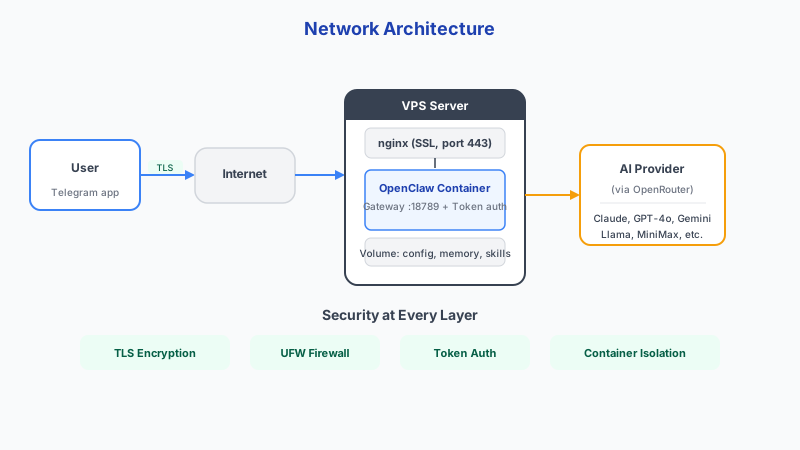
OpenClaw is a complete, deployable AI agent runtime. You pull a Docker image, add your configuration (API keys, channel tokens, model preferences), and you have a working AI agent in 5-15 minutes. It handles conversation management, memory persistence, channel integrations, skill execution, and scheduling. You interact with your agent through messaging apps — no code required for basic use.
LangChain is a Python/JavaScript framework that provides components for building AI applications. It gives you abstractions for LLM calls (chains), memory management, document loading, vector stores, agents, tools, and output parsing. You use these components to write code that creates a custom application. There is no deployable agent out of the box — you build one from the parts LangChain provides.
An analogy: OpenClaw is like buying a car. LangChain is like buying an engine, transmission, chassis, and wheels separately and assembling them yourself. Both get you transportation, but the effort, flexibility, and outcome are very different.
This distinction means they serve different audiences. OpenClaw serves people who want a personal AI agent. LangChain serves developers who want to build AI-powered applications. There is overlap — a developer might use LangChain to build something similar to OpenClaw — but the starting points and intended workflows are fundamentally different.
Feature Comparison Table
This table highlights the key differences between OpenClaw as a runtime and LangChain as a framework.
Feature Comparison: OpenClaw vs LangChain (2026)

| Feature                  | OpenClaw                                  | LangChain                                  |
|--------------------------|-------------------------------------------|--------------------------------------------|
| Category                 | Complete agent runtime                    | Developer framework / library              |
| Deployment               | Docker container (ready to run)           | Custom app (you build and deploy)          |
| Setup time               | 5-15 minutes                              | Hours to weeks (depends on scope)          |
| Coding required          | No (config-driven)                        | Yes (Python or JavaScript)                 |
| Memory                   | Built-in persistent memory                | Memory components (you wire them up)       |
| Channel integrations     | Telegram, Discord, WhatsApp (native)      | None (build your own)                      |
| LLM support              | Any model via OpenRouter (50+ models)     | Any model (via provider integrations)      |
| Conversation management  | Built-in session + history                | ConversationChain (you implement)          |
| Skill system             | Markdown skills + ClawHub                 | Tools + agents (you define)                |
| Vector database          | Not required                              | Supported (Pinecone, Chroma, etc.)         |
| RAG (retrieval)          | Via skills and tools                      | First-class support (document loaders)     |
| Scheduling               | Built-in cron + heartbeat                 | Not included (use external scheduler)      |
| Customization            | Config + skills                           | Unlimited (full code access)               |
| Learning curve            | Low (config + messaging)                  | High (Python + AI concepts + architecture) |
| Production readiness     | Production-ready                          | Framework-level (your app determines this) |
| Community                | ClawHub skills library                    | Large ecosystem (PyPI packages, templates) |
| Best for                 | Personal AI agent users                   | Developers building custom AI apps         |
| Managed hosting          | DoneClaw ($29/mo)                         | LangServe / custom deployment              |
Memory and State Management
Memory is a core feature in both platforms, but implemented very differently. OpenClaw treats memory as a first-class citizen that works out of the box. Every conversation is automatically stored and retrievable. Your agent builds a persistent knowledge base about you, your preferences, your projects, and your contacts without any configuration beyond the initial setup.
LangChain provides memory components that you wire into your application. Options include ConversationBufferMemory (stores full conversation history), ConversationSummaryMemory (stores summaries), ConversationBufferWindowMemory (stores the last K messages), and VectorStoreRetrieverMemory (stores and retrieves using vector similarity). Each has trade-offs in cost, recall quality, and complexity.
The practical difference is significant. With OpenClaw, memory just works — your agent remembers everything from day one. With LangChain, you choose a memory strategy, implement it, tune the parameters, handle edge cases (what happens when the context window fills up?), and maintain the infrastructure (vector database, storage). For a developer building a product, this flexibility is valuable. For a user who wants a working agent, it is unnecessary complexity.
LangChain's memory components do offer capabilities that OpenClaw does not expose directly: entity memory (tracking specific entities across conversations), knowledge graph memory (building structured relationships), and custom memory backends. If your use case requires a specific memory architecture, LangChain gives you the control to build it.
Building with LangChain vs Using OpenClaw
To illustrate the difference concretely, consider building a personal AI assistant that responds to Telegram messages, remembers past conversations, and can execute scheduled tasks.
With OpenClaw, you create a config file specifying your Telegram bot token, your OpenRouter API key, and your model preference. You run docker compose up. You start messaging your bot in Telegram. Total time: 10-15 minutes. Total code written: zero.
With LangChain, you write a Python application that initializes a ChatOpenAI model, creates a ConversationBufferMemory or VectorStoreRetrieverMemory, builds an agent with tools, integrates the python-telegram-bot library for Telegram connectivity, implements message handling and conversation routing, sets up a database for persistent storage, adds a scheduler (APScheduler or Celery) for scheduled tasks, handles error recovery and reconnection, and deploys the whole thing to a server. Total time: 2-5 days for a minimum viable version. Total code written: 500-2,000 lines.
The LangChain version gives you more control — you can customize every aspect of the agent's behavior, add custom tools, implement sophisticated memory strategies, and integrate with any service. The OpenClaw version gives you a working product immediately, with customization available through skills and configuration.
This trade-off is the fundamental choice: time-to-value versus customization depth. For most personal AI assistant use cases, OpenClaw's time-to-value advantage is decisive. For custom AI applications with specific requirements, LangChain's flexibility is essential.
LLM and Model Support
Both platforms support a wide range of LLMs, but through different mechanisms.
OpenClaw connects to models through OpenRouter, which provides unified access to 50+ models from OpenAI, Anthropic, Google, Meta, Mistral, and others. You set your model preference in the config file, and OpenClaw handles the API formatting. Switching models is a one-line config change. You can also use different models for different tasks through the secondary model slot.
LangChain has direct integrations with virtually every LLM provider: OpenAI, Anthropic, Google, Hugging Face, Ollama, vLLM, and dozens more. Each provider has a dedicated LangChain class with provider-specific options. This gives you more control — you can fine-tune parameters, use provider-specific features, and switch providers at the code level.
For most users, OpenClaw's OpenRouter integration is simpler and sufficient. You get access to all major models through a single API key, and switching between them is trivial. LangChain's direct provider integrations matter when you need provider-specific features (like OpenAI's function calling with specific parameters, or Anthropic's system prompt caching) or when you want to run local models through Ollama or vLLM.
Try DoneClaw free for 7 days — cancel anytime
Full access during your trial. No credit card charged until day 8. Cancel from the Stripe portal with one click.
Try Free for 7 DaysRAG and Document Processing
Retrieval-Augmented Generation (RAG) is one of LangChain's strongest areas. LangChain provides document loaders for dozens of file types (PDF, CSV, HTML, Notion, Google Docs, and more), text splitters for chunking documents, embedding models for vectorization, vector stores for storage and retrieval (Pinecone, Chroma, Weaviate, FAISS, and others), and retrieval chains that combine search results with LLM prompts.
OpenClaw does not have built-in RAG infrastructure. However, you can implement document-based workflows through skills and tools. A skill can read a file, search through it, and use the contents in conversation. For simple document Q&A, this works well. For large-scale document processing with vector search across thousands of documents, LangChain's RAG pipeline is significantly more capable.
If RAG is your primary use case — building a chatbot that answers questions from a knowledge base of documents — LangChain is the better choice. If RAG is a secondary feature and your primary need is a personal AI assistant, OpenClaw's simpler approach is sufficient for most users.
Cost Comparison
The cost structures differ primarily in engineering time, not infrastructure.
OpenClaw's cost is predictable: $5-20 per month for a VPS (if self-hosted) or $29 per month for DoneClaw managed hosting, plus LLM API costs through OpenRouter. Setup time is minimal, and ongoing maintenance is 1-2 hours per month.
LangChain's cost is heavily front-loaded in development time. The framework itself is free and open-source, but building a production application requires significant engineering effort. A solo developer building a personal assistant equivalent to OpenClaw might spend 20-40 hours of development time. A team building a customer-facing product could spend weeks or months. Infrastructure costs depend on what you build: a simple app might run on a $10 per month VPS, while a RAG pipeline with vector databases might cost $50-200 per month.
LLM API costs are similar for both platforms once running. LangChain offers more fine-grained control over token usage through custom prompting and caching strategies, which can reduce costs for high-volume applications. OpenClaw's token usage is efficient for conversational workloads but less optimizable for custom use cases.
For personal use, OpenClaw (or DoneClaw) is dramatically cheaper in total cost of ownership when you account for development time. For a funded startup building a custom AI product, LangChain's development cost is an investment in a differentiated product.
The No-Code Alternative: DoneClaw
DoneClaw at doneclaw.com is the managed hosting service for OpenClaw that eliminates all technical complexity. If you are comparing OpenClaw and LangChain because you want a personal AI agent and are trying to figure out which technical approach to take, DoneClaw might be the answer that makes the comparison irrelevant.
With DoneClaw, you sign up, connect your Telegram or Discord account, and your AI agent is running in under 5 minutes. No Docker, no server management, no configuration files, no API key setup (beyond the model provider). DoneClaw handles container provisioning, automatic updates, SSL certificates, channel integration, and monitoring.
DoneClaw costs $29 per month plus model API usage. For someone considering spending 20-40 hours building a LangChain application to get a personal AI assistant, DoneClaw provides the same end result at a fraction of the total cost.
The trade-off is customization. DoneClaw (and OpenClaw generally) gives you less control than a custom LangChain application. If you need specific memory strategies, custom RAG pipelines, or deep integration with proprietary systems, LangChain's framework approach is necessary. If you need a reliable personal AI assistant that works today, DoneClaw is the fastest path.
When to Choose Each
Choose OpenClaw (or DoneClaw) if you want a personal AI agent that works immediately, lives in your messaging apps, and remembers everything. You do not need to write code, manage complex infrastructure, or understand AI engineering concepts. OpenClaw is the right choice for individuals, small teams, and anyone who values time-to-value over customization.
Choose LangChain if you are a developer building a custom AI application. You need fine-grained control over memory, retrieval, prompting, and tool execution. Your use case has specific requirements that a general-purpose agent runtime cannot meet. LangChain is the right choice for startups building AI products, enterprises with custom integration needs, and developers who want to learn AI engineering by building.
Some use cases genuinely require LangChain's framework approach: RAG-heavy applications with large document corpuses, multi-agent systems with complex coordination, AI applications with custom user interfaces, products that need to work with proprietary or fine-tuned models, and applications with strict compliance or data residency requirements.
For everything else — personal AI assistant, daily productivity tool, team communication bot, scheduled automation — OpenClaw delivers the result faster, cheaper, and with less ongoing maintenance.
Community and Ecosystem Comparison
LangChain has one of the largest AI developer communities in 2026. The Python package has millions of downloads, thousands of GitHub stars, and a rich ecosystem of integrations, templates, and community-contributed components. LangChain Hub provides reusable prompts and chains. LangSmith offers observability and debugging tools. LangServe provides deployment infrastructure. The ecosystem is comprehensive and well-supported.
OpenClaw's community is focused on practical agent use rather than AI development. ClawHub provides pre-built skills that non-developers can install and customize. Community discussions center on skill sharing, configuration tips, and real-world use cases. The community is smaller but more accessible to non-developers.
The community difference reflects the audience difference. LangChain's community is full of developers sharing code, debugging chains, and building products. OpenClaw's community is full of users sharing skills, comparing model choices, and discussing productivity workflows. Both are active and helpful, but for very different types of questions.
If you are a developer who wants to learn AI engineering, LangChain's community and documentation are excellent resources. If you want a working agent and practical tips for getting more out of it, OpenClaw's community is more directly useful.
Can You Use Both Together?
Yes, and there are valid reasons to do so. OpenClaw handles your daily personal AI needs — conversational assistance, memory, messaging app integration, scheduled skills. LangChain powers custom applications that you build for specific purposes — a RAG chatbot for your company's documentation, a data processing pipeline, a customer support automation.
The two do not compete for resources. OpenClaw runs as a Docker container on a VPS. LangChain applications run wherever you deploy them. They can even communicate with each other through webhooks: an OpenClaw skill could trigger a LangChain application for complex document processing, or a LangChain application could send results to your OpenClaw agent for summary and delivery to your Telegram.
This combined approach gives you the best of both worlds: the instant utility of a pre-built agent for personal use, and the unlimited flexibility of a developer framework for custom applications. Many teams end up with this architecture naturally — they start with OpenClaw for immediate value, then build LangChain applications for specific business needs that require custom logic.
Conclusion
OpenClaw and LangChain are complementary rather than competitive. OpenClaw is where you go when you want a working AI agent today. LangChain is where you go when you want to build a custom AI application from components. For personal AI assistant use, OpenClaw (or DoneClaw managed hosting at doneclaw.com) is the clear winner on time-to-value, cost, and ease of use. For custom AI product development, LangChain's framework provides the flexibility and control that developers need. Choose based on what you are building, not on which is 'better' in the abstract.
Skip the setup? DoneClaw deploys OpenClaw for you — $29/mo with 7-day free trial, zero configuration.
Try DoneClaw free for 7 days — cancel anytime
Full access during your trial. No credit card charged until day 8. Cancel from the Stripe portal with one click.
Try Free for 7 DaysFrequently asked questions
Is OpenClaw built on LangChain?
No. OpenClaw is an independent runtime built with Node.js. It does not use LangChain as a dependency. They are separate projects with different architectures and target audiences.
Can I use LangChain to build something like OpenClaw?
Yes, but it would take significant development effort. You would need to implement conversation management, persistent memory, channel integrations (Telegram, Discord, WhatsApp), skill execution, scheduling, and deployment infrastructure. OpenClaw provides all of this out of the box.
Which is easier to learn, OpenClaw or LangChain?
OpenClaw is significantly easier. It requires no programming knowledge — just configuration files and messaging app interaction. LangChain requires Python or JavaScript proficiency, understanding of AI concepts (embeddings, vector stores, chains, agents), and software engineering skills for deployment and maintenance.
Does LangChain have messaging app integrations like OpenClaw?
Not built-in. LangChain does not include Telegram, Discord, or WhatsApp integrations. You would need to integrate those separately using Python libraries like python-telegram-bot, discord.py, or third-party APIs, and wire them into your LangChain application yourself.
Which is better for RAG applications?
LangChain is better for RAG. It has first-class support for document loading, text splitting, embeddings, vector stores, and retrieval chains. OpenClaw can handle simple document Q&A through skills, but it is not designed for large-scale RAG pipelines.