Comparisons
OpenClaw vs Custom ChatGPT: Personal AI Agent Comparison (2026)
14 min read · Updated 2026-03-06
By DoneClaw Team · We run managed OpenClaw deployments and write from hands-on production experience.
Custom ChatGPTs (OpenAI's GPTs) let you create specialized versions of ChatGPT with custom instructions, knowledge files, and actions. OpenClaw gives you a full AI agent runtime with persistent memory, messaging app integration, and model flexibility. Both promise a personalized AI experience, but they deliver it in fundamentally different ways. This comparison covers every dimension that matters: memory, privacy, integrations, model choice, customization depth, cost, and real-world usability. Whether you are currently using a Custom ChatGPT and wondering if there is something better, or evaluating both options for the first time, this guide helps you make an informed decision. For those who want OpenClaw without managing servers, DoneClaw at doneclaw.com offers fully managed hosting with your agent running in under 5 minutes.
What Are Custom ChatGPTs?
Custom ChatGPTs (GPTs) are specialized versions of ChatGPT that you create through OpenAI's GPT Builder. You define custom instructions that shape the AI's behavior, upload knowledge files that the AI can reference, configure actions that connect to external APIs, and publish the GPT for personal use or share it in the GPT Store.
GPTs are designed to be easy to create. The GPT Builder is a conversational interface where you describe what you want, and it generates the configuration. No coding is required. The result is a custom chatbot that lives within the ChatGPT interface and behaves according to your instructions.
The key limitation of GPTs is that they operate within ChatGPT's constraints. They run on OpenAI's infrastructure, use only OpenAI's models, have limited memory across conversations, and require you to visit the ChatGPT website or app to use them. They are customizations of ChatGPT, not independent AI agents.
GPTs require a ChatGPT Plus subscription ($20 per month) or ChatGPT Team ($25 per user per month) to create and use. The GPT Store provides access to thousands of community-built GPTs across categories like writing, productivity, research, and coding.
What Is OpenClaw?
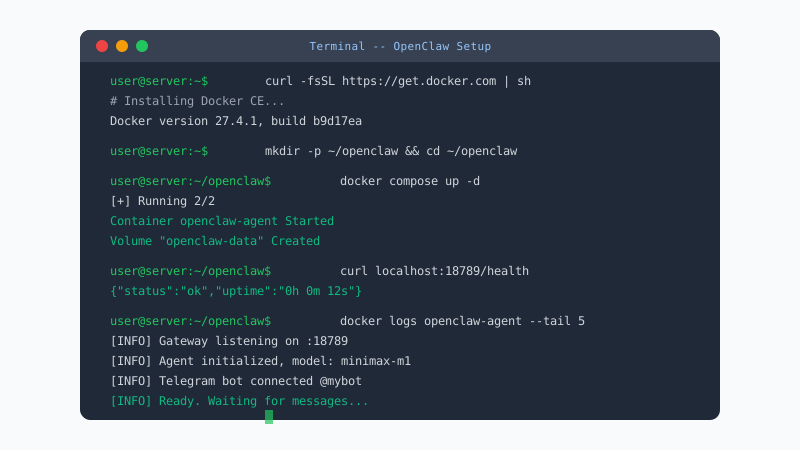
OpenClaw is an open-source AI agent runtime that runs as a Docker container on your own infrastructure. It provides a persistent, always-on AI agent with built-in conversation memory, channel integrations (Telegram, Discord, WhatsApp), support for any LLM via OpenRouter, and a skill system for task automation.
Unlike GPTs, OpenClaw is not a customization layer on top of someone else's platform. It is a standalone agent that you own and control. Your data stays on your infrastructure. You choose which models to use. You decide what integrations to enable. The agent runs 24/7, remembers everything, and meets you in the messaging apps you already use.
OpenClaw can be self-hosted on any VPS for $5-20 per month, or you can use DoneClaw managed hosting at $29 per month for a fully configured agent with no server management required.
Feature Comparison Table
This table covers every major feature where OpenClaw and Custom ChatGPT differ.
Feature Comparison: OpenClaw vs Custom ChatGPT (2026)

| Feature                  | OpenClaw                                  | Custom ChatGPT (GPTs)                      |
|--------------------------|-------------------------------------------|--------------------------------------------|
| Type                     | Standalone AI agent runtime               | Customization of ChatGPT                   |
| Memory                   | Full persistent memory (indefinite)       | Limited memory (selective, occasionally lost)|
| Always-on                | Yes (24/7 Docker container)               | No (active only when you visit ChatGPT)    |
| Channel integrations     | Telegram, Discord, WhatsApp (native)      | ChatGPT app/website only                   |
| Model flexibility        | 50+ models via OpenRouter                 | OpenAI models only (GPT-4o, GPT-4, etc.)  |
| Custom knowledge         | Skills + memory + file access             | Knowledge files (upload limit)             |
| Custom actions           | Skills + webhooks + cron jobs             | Actions (API calls, limited)               |
| Scheduling               | Cron jobs, heartbeat, timed skills        | No scheduling capability                   |
| Privacy                  | Your infrastructure, your data            | OpenAI infrastructure, shared processing   |
| Data ownership           | Full (your server, your volume)           | OpenAI's terms of service                  |
| Offline access           | Via messaging apps (cached)               | Requires internet + ChatGPT servers        |
| Multi-model per task     | Yes (primary + secondary model)           | No (locked to selected model)              |
| File handling            | Full filesystem inside container          | Upload/download within ChatGPT UI          |
| API access               | Full HTTP API per agent                   | No user-facing API for GPTs                |
| Cost                     | $5-20/mo self-hosted or $29/mo managed    | $20/mo ChatGPT Plus (required)             |
| Setup complexity         | Moderate (Docker + config)                | Very low (conversational builder)          |
| Customization depth      | Deep (config, skills, cron, integrations) | Shallow (instructions, files, actions)     |
| Community ecosystem      | ClawHub skills library                    | GPT Store (thousands of GPTs)              |
Memory: The Decisive Difference
Memory is the single biggest gap between OpenClaw and Custom ChatGPT, and it is the feature that determines whether your AI is a genuine assistant or a knowledgeable stranger.
Custom ChatGPT has a memory feature that stores short facts about you: 'user prefers Python', 'user works in marketing', 'user's dog is named Max'. This memory is selective — ChatGPT decides what to remember — and it is fragile. Users regularly report that memories disappear, that ChatGPT forgets details that were explicitly stored, and that the memory system is inconsistent. You cannot rely on ChatGPT remembering a detailed conversation from two weeks ago.
OpenClaw maintains full, persistent memory of every conversation, indefinitely. Nothing is selectively discarded. Your preferences, past decisions, project context, personal details, and every interaction are retained and retrievable. After one week of use, your OpenClaw agent understands your context better than ChatGPT ever will. After one month, the difference is dramatic.
A concrete example illustrates the gap. You spend 30 minutes discussing your Q2 marketing strategy with your AI. You mention budget figures, target audiences, campaign ideas, and deadlines. Two weeks later, you ask 'what did we decide about the Q2 social media budget?' With OpenClaw, the agent retrieves the exact figures and context from that conversation. With Custom ChatGPT, the agent likely has no memory of the discussion and asks you to repeat everything.
For anyone who uses AI as a daily tool rather than an occasional question-answerer, this memory gap is the strongest reason to choose OpenClaw.
Privacy and Data Ownership
Privacy is a growing concern in AI, and the architectural differences between OpenClaw and Custom ChatGPT create very different privacy profiles.
Custom ChatGPTs run entirely on OpenAI's infrastructure. Your conversations, uploaded knowledge files, and interaction history are stored on OpenAI's servers under their terms of service. OpenAI states that they may use your data to improve their models (you can opt out via settings, but the data still resides on their servers). For personal use, this may be acceptable. For business use involving sensitive client data, financial information, or proprietary knowledge, it is a significant concern.
OpenClaw runs on your own infrastructure — a VPS you control, or DoneClaw's managed hosting where each user gets an isolated Docker container. Your conversation history, memory, and configuration files live in a Docker volume on your server. No third party has access to your data beyond the LLM API calls (which send individual messages to the model provider for processing). You can choose model providers based on their data policies, use local models via Ollama for complete data isolation, or configure your own proxy to control exactly what leaves your server.
For professionals working with client data, healthcare information, legal documents, or financial records, OpenClaw's self-hosted model provides a level of data control that Custom ChatGPT cannot match. You know exactly where your data is, who has access, and what happens to it.
Try DoneClaw free for 7 days — cancel anytime
Full access during your trial. No credit card charged until day 8. Cancel from the Stripe portal with one click.
Try Free for 7 DaysModel Flexibility: One Vendor vs Many
Custom ChatGPTs are locked into OpenAI's model ecosystem. You get GPT-4o, GPT-4, and GPT-3.5. These are excellent models, but they are not always the best choice for every task. Claude Opus outperforms GPT-4 on nuanced reasoning and long-form writing. Gemini Flash is faster and cheaper for simple queries. Llama models are free to run locally.
OpenClaw connects to 50+ models through OpenRouter: Claude Opus, Claude Sonnet, Claude Haiku, GPT-4o, GPT-4, Gemini Pro, Gemini Flash, Llama 3.1, Mistral Large, Mixtral, and many more. You switch models with a single config change. You can use different models for different types of tasks — a powerful model for complex reasoning, a fast model for simple lookups, a cheap model for scheduled background tasks.
The ability to switch models also provides vendor resilience. If one provider has an outage, you switch to another. If pricing changes, you migrate. With Custom ChatGPT, you are entirely dependent on OpenAI's availability, pricing, and policy decisions.
For cost-conscious users, model flexibility is particularly valuable. Running your daily interactions through Gemini Flash ($0.075 per million tokens) instead of GPT-4o ($5 per million tokens) can reduce API costs by 60x for tasks where the cheaper model is sufficient.
Channel Integrations: Browser Tab vs Messaging Apps
Custom ChatGPTs live in the ChatGPT web interface or the OpenAI mobile app. Every time you want to use your AI, you open the app, navigate to your GPT, and start typing. When you are done, you close the tab. The AI is dormant until your next visit.
OpenClaw integrates natively with Telegram, Discord, and WhatsApp. Your AI agent appears as a contact in the messaging app you already use every day. You interact with it the same way you text a friend — tap the contact, send a message, get a response. The agent is always on, always reachable, always in context.
This seems like a convenience feature, but it fundamentally changes usage patterns. ChatGPT users typically have 3-5 sessions per day, each requiring a deliberate decision to open the app. OpenClaw users with Telegram integration typically have 15-30 interactions per day, many of them quick one-off queries that they would never bother opening a separate app for.
More interactions means more context in memory, which means the agent becomes more useful faster. It is a virtuous cycle: easier access leads to more use, which leads to better memory, which leads to better responses, which leads to more use.
Custom ChatGPT does have a mobile app, which reduces friction somewhat. But it is still a separate app you must switch to, not a contact in your existing chat. The difference between switching apps and messaging within your current app is significant for daily adoption.
Scheduling and Proactive Behavior
Custom ChatGPTs are entirely reactive — they do nothing until you open the chat and send a message. There is no way to schedule a GPT to run a task at 7am, send you a daily briefing, or check your services every 30 minutes. The GPT sits dormant between your visits.
OpenClaw supports cron jobs and scheduled skills that turn your agent from reactive to proactive. Your morning briefing runs at 7am and sends results to your Telegram. Your deploy checker pings your services every 30 minutes. Your expense tracker sends a daily summary at 6pm. Your news digest arrives at 8am and 5pm. The agent reaches out to you with relevant information instead of waiting for you to ask.
This proactive capability is one of the core differences between a chatbot and an agent. A chatbot answers when asked. An agent works on your behalf, unprompted, based on schedules and triggers you define. Custom ChatGPT is a chatbot. OpenClaw is an agent.
DoneClaw managed hosting includes scheduling configuration through a web dashboard, making it easy to set up proactive skills without touching cron or command line.
Customization Depth
Custom ChatGPTs offer three layers of customization: instructions (a system prompt that shapes behavior), knowledge (uploaded files the GPT can reference), and actions (API calls to external services). This is sufficient for many use cases — a customer service bot, a writing assistant, a coding helper — but it hits limits quickly when you need the agent to do more.
GPTs cannot run scheduled tasks, maintain persistent state across conversations reliably, access a filesystem, execute arbitrary code, or integrate with messaging apps. The customization is shallow by design — GPTs are meant to be easy to create, not deeply programmable.
OpenClaw's customization goes much deeper. Skills are markdown files that define complex task workflows. Cron jobs enable scheduled execution. The agent has filesystem access inside its container. Webhooks enable external service integration. Memory is fully persistent and queryable. Channel integrations bring the agent into your existing communication tools. You can write custom tools, chain skills together, and build workflows that run autonomously.
The trade-off is setup complexity. Creating a Custom ChatGPT takes 5 minutes in the GPT Builder. Configuring an advanced OpenClaw setup with multiple skills, cron jobs, and channel integrations takes 30-60 minutes. DoneClaw reduces this to 5-10 minutes for basic setups.
Cost Comparison
Custom ChatGPT requires a ChatGPT Plus subscription at $20 per month. This gives you access to GPT-4o, GPT-4, DALL-E, browsing, file uploads, and the ability to create and use GPTs. The price is fixed regardless of usage (with rate limits on GPT-4).
OpenClaw self-hosted costs $5-20 per month for a VPS plus LLM API costs through OpenRouter. API costs vary by model and usage: a light user might spend $15-30 per month, a heavy user $50-90 per month. DoneClaw managed hosting is $29 per month plus API costs.
For light users, ChatGPT Plus at $20 per month (all-inclusive) is cheaper. For moderate to heavy users who want persistent memory, messaging app integration, and model flexibility, OpenClaw at $29-60 per month total provides significantly more value. The DoneClaw managed plan at $29 per month is only $9 more than ChatGPT Plus but includes persistent memory, Telegram/Discord/WhatsApp integration, scheduling, and access to 50+ models.
When evaluating cost, consider what you are paying for. ChatGPT Plus gives you access to a powerful chat interface with limited memory. DoneClaw gives you a dedicated AI agent with full memory, proactive scheduling, and messaging app integration. The $9 difference buys a qualitatively different experience.
When to Choose Each
Choose Custom ChatGPT if you want the simplest possible setup, need image generation (DALL-E), are satisfied with OpenAI's models, do not need persistent memory across conversations, and primarily use AI through a browser or the OpenAI app. GPTs are excellent for quick one-off customizations and the GPT Store provides thousands of pre-built options.
Choose OpenClaw (or DoneClaw) if you need persistent memory that truly remembers everything, want your AI in Telegram, Discord, or WhatsApp, need model flexibility beyond OpenAI, want proactive scheduled tasks, care about data privacy and ownership, or need deep customization through skills and cron jobs.
For professionals who use AI as a daily tool — not an occasional helper — OpenClaw's advantages in memory, integration, and automation compound over time. The first week might feel similar to ChatGPT. After a month, the persistent memory and proactive skills make OpenClaw dramatically more useful.
For casual AI users who ask occasional questions and do not need their AI to remember context, Custom ChatGPT's simplicity and lower starting cost make it a reasonable choice.
Conclusion
Custom ChatGPT and OpenClaw serve the same fundamental need — a personalized AI experience — but deliver it at very different levels of depth. Custom ChatGPT is the entry point: easy to create, easy to use, limited in memory and integration. OpenClaw is the full realization: persistent memory, messaging app integration, model flexibility, proactive automation, and data ownership. For anyone ready to move beyond a chat window into a genuine AI agent experience, OpenClaw (or DoneClaw managed hosting at doneclaw.com) is the upgrade that changes how you use AI daily.
Skip the setup? DoneClaw deploys OpenClaw for you — $29/mo with 7-day free trial, zero configuration.
Try DoneClaw free for 7 days — cancel anytime
Full access during your trial. No credit card charged until day 8. Cancel from the Stripe portal with one click.
Try Free for 7 DaysFrequently asked questions
Is OpenClaw better than Custom ChatGPT?
For daily use as a personal AI assistant, yes. OpenClaw offers persistent memory, messaging app integration, model flexibility, and proactive scheduling that Custom ChatGPT lacks. Custom ChatGPT is easier to set up and includes DALL-E image generation, making it better for casual or occasional use.
Can Custom ChatGPT remember conversations like OpenClaw?
Not reliably. ChatGPT's memory feature stores selective short facts and occasionally loses them. OpenClaw maintains full, persistent memory of every conversation indefinitely. The difference becomes dramatic after a few weeks of use.
Does OpenClaw work with Telegram?
Yes. OpenClaw has native Telegram integration. Your AI agent appears as a contact in Telegram, and you interact with it the same way you message a friend. It also supports Discord and WhatsApp. Custom ChatGPT only works through the ChatGPT website and app.
Is Custom ChatGPT more private than OpenClaw?
No. Custom ChatGPT runs on OpenAI's shared infrastructure under their terms of service. OpenClaw runs on your own server (or an isolated DoneClaw container), giving you full control over your data. For privacy-sensitive use cases, OpenClaw is significantly better.
Can I switch from Custom ChatGPT to OpenClaw?
Yes. There is no data migration needed since ChatGPT's memory is limited anyway. Sign up for DoneClaw at doneclaw.com, connect your messaging app, and start building new context with your OpenClaw agent. Most users report that after one week of use, their OpenClaw agent has more useful context than their ChatGPT ever accumulated.