Comparisons
OpenClaw vs AutoGPT: Which AI Agent Platform is Better? (2026)
14 min read · Updated 2026-03-06
By DoneClaw Team · We run managed OpenClaw deployments and write from hands-on production experience.
AutoGPT was one of the first projects to capture public imagination about autonomous AI agents when it launched in 2023. OpenClaw took a different approach, focusing on practical daily utility over ambitious autonomy. Both platforms let you run AI agents, but they differ fundamentally in architecture, reliability, cost, and intended use case. This comparison breaks down every dimension that matters: how each platform works, what it costs, how reliable it is, how easy it is to set up, and which one is the better fit for different use cases. If you are choosing between OpenClaw and AutoGPT in 2026, this guide gives you everything you need to decide. For those who want OpenClaw without managing infrastructure, DoneClaw at doneclaw.com provides fully managed hosting with automatic updates, SSL, and channel integrations pre-configured.
Architecture: Fundamentally Different Approaches
AutoGPT is built around the concept of autonomous goal pursuit. You give it a high-level goal — 'research competitors and write a market analysis' — and it attempts to break that goal into subtasks, execute them sequentially, and deliver a final result. The agent runs in a loop: think, act, observe, repeat. This loop continues until the goal is achieved or the agent gets stuck.
OpenClaw is built around conversational interaction with persistent memory. You talk to your agent naturally through messaging apps (Telegram, Discord, WhatsApp), and it remembers everything across conversations. Instead of autonomous goal pursuit, OpenClaw focuses on being a reliable assistant that knows your context and can execute specific tasks through skills and cron jobs.
The architectural difference creates a core trade-off. AutoGPT aims for autonomy — the agent works independently toward a goal. OpenClaw aims for reliability — the agent responds to your commands and maintains context over time. In practice, AutoGPT's autonomous loops often get stuck or go off-track, while OpenClaw's conversational approach consistently delivers useful results because a human is guiding the interaction.
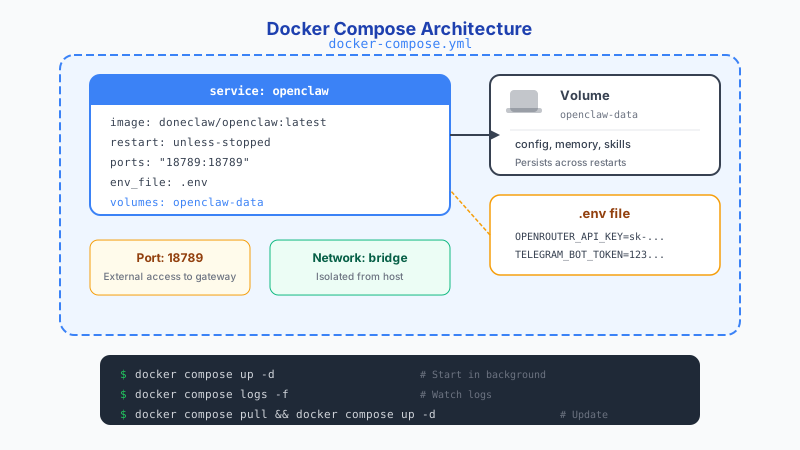
AutoGPT runs as a Python application that can use various tools: web browsing, file operations, code execution, and API calls. It maintains a short-term memory within a task and uses vector databases for longer-term recall. OpenClaw runs as a Docker container with a Node.js runtime, maintaining conversation history in JSONL session files and structured memory in a dedicated memory system that persists indefinitely.
Feature Comparison Table
This table summarizes the key differences between OpenClaw and AutoGPT across every major feature dimension.
Feature Comparison: OpenClaw vs AutoGPT (2026)

| Feature                  | OpenClaw                                  | AutoGPT                                    |
|--------------------------|-------------------------------------------|--------------------------------------------|
| Primary approach         | Conversational agent + persistent memory  | Autonomous goal-pursuing agent             |
| Deployment               | Single Docker container                   | Python app + dependencies                  |
| Memory                   | Persistent across all conversations       | Per-task + vector DB (limited persistence) |
| LLM support              | Any model via OpenRouter (50+ models)     | OpenAI primary, others via plugins         |
| Channel integrations     | Telegram, Discord, WhatsApp (native)      | CLI only (no messaging app integration)    |
| Autonomy level           | Human-guided with scheduled automation    | Fully autonomous (with frequent failures)  |
| Skill system             | Markdown-based skills + ClawHub           | Plugins + custom commands                  |
| Reliability              | High (human in the loop)                  | Low-moderate (autonomous loops get stuck)  |
| Setup time               | 5-15 minutes                              | 30-60 minutes                              |
| Self-hosted cost         | $5-20/mo VPS + model API                  | Free + model API (higher token usage)      |
| Managed hosting          | $29/mo (DoneClaw)                         | Limited options                            |
| Token efficiency         | Moderate (conversational)                 | Low (reasoning loops consume many tokens)  |
| Best for                 | Daily AI assistant, ongoing tasks         | One-off research, autonomous experiments   |
| Community size           | Growing (ClawHub skills library)          | Large (early mover advantage)              |
| Maintenance              | 1-2 hours/month                           | 3-5 hours/month (dependency management)    |
| Production readiness     | Production-ready                          | Experimental/hobby                         |
Deployment and Setup
OpenClaw deployment is straightforward: pull a Docker image, create a configuration file with your API keys and channel tokens, and run docker compose up. The entire process takes 5-15 minutes. Docker handles all dependencies, and the container is self-contained. Updates are a single command: docker pull and restart.
AutoGPT setup requires Python 3.10+, pip, and manual dependency installation. You need to clone the repository, install requirements, configure environment variables, and potentially set up a vector database (Pinecone, Weaviate, or ChromaDB) for memory persistence. The setup process typically takes 30-60 minutes, and dependency conflicts are common, especially on systems with other Python projects.
For ongoing maintenance, OpenClaw requires minimal effort. Docker containers are isolated, updates are atomic, and configuration changes are a single JSON file edit. AutoGPT requires more active maintenance: Python dependency updates, occasional breaking changes between versions, and vector database management. The Python ecosystem moves fast, and AutoGPT's dependency tree is larger.
DoneClaw eliminates deployment entirely for OpenClaw users. Sign up at doneclaw.com, connect your messaging app, and your agent is running in under 5 minutes with no command line needed.
Memory: Persistent Context vs Task Memory
Memory is where OpenClaw has a decisive advantage. OpenClaw maintains persistent memory across every conversation, indefinitely. Your agent remembers your preferences, past decisions, project details, contacts, and every interaction you have had. After a week of use, the agent genuinely understands your context. After a month, it becomes a personalized assistant that knows your work style, your priorities, and your history.
AutoGPT's memory model is task-scoped. Within a single task execution, the agent maintains a working memory of what it has done and what it needs to do next. For longer-term recall, AutoGPT uses vector databases to store and retrieve relevant information. However, this memory is not conversational — it is a keyword-based retrieval system that works well for factual lookups but poorly for understanding context, relationships, and nuance.
A practical example: you mention to your OpenClaw agent that your client prefers email communication over Slack. Three weeks later, when you ask the agent to draft a message to that client, it automatically suggests an email rather than a Slack message. AutoGPT would not retain this kind of contextual preference between task executions.
The memory gap matters most for ongoing personal use. If you want an AI that gets better at helping you over time, OpenClaw's persistent conversational memory is essential. If you want an AI that executes isolated tasks without needing personal context, AutoGPT's task-scoped memory is sufficient.
Cost and Token Efficiency
Cost is a significant differentiator, and it consistently favors OpenClaw for regular use. The reason is token efficiency: AutoGPT's autonomous reasoning loops consume far more tokens than OpenClaw's conversational interactions.
AutoGPT works by running a think-act-observe loop. Each iteration of this loop sends a prompt to the LLM that includes the goal, the current state, the history of actions taken, and a request for the next action. A single task might require 10-50 loop iterations, each consuming thousands of tokens. A research task that would cost $0.05 in a direct conversation might cost $0.50-2.00 in AutoGPT due to the reasoning overhead.
OpenClaw's conversational model is more token-efficient. Each message exchange sends the user's message plus relevant context from memory, and receives a response. There is no reasoning loop — the human provides the direction, and the agent executes. A typical day of moderate OpenClaw usage (20-30 messages) costs $0.50-2.00 in API tokens. The same level of task completion through AutoGPT would cost 3-5x more.
Infrastructure costs are similar: both can run on a $5-20 per month VPS. AutoGPT may require additional database costs if using a hosted vector database. DoneClaw managed hosting at $29 per month eliminates infrastructure management for OpenClaw users.
For budget-conscious users, OpenClaw's predictable, conversation-based token usage is easier to plan for than AutoGPT's variable, loop-based consumption.
Try DoneClaw free for 7 days — cancel anytime
Full access during your trial. No credit card charged until day 8. Cancel from the Stripe portal with one click.
Try Free for 7 DaysReliability and Real-World Performance
Reliability is perhaps the most important practical difference. OpenClaw is a production-ready tool that delivers consistent results because the human remains in the loop. AutoGPT is an experimental platform that produces impressive results when its autonomous loops work correctly, but frequently gets stuck, loops infinitely, or pursues the wrong approach.
AutoGPT's autonomous nature is both its greatest strength and its biggest weakness. When it works, the experience is magical: you set a goal and come back to a completed task. When it fails — which happens in 30-60% of complex tasks in real-world usage — you have spent tokens and time with nothing to show for it. The failure modes are unpredictable: the agent might get stuck in a loop, misinterpret the goal, or take actions that are technically correct but practically useless.
OpenClaw's reliability comes from its conversational design. When you ask your agent to research a topic, you see the results in real-time and can redirect if it goes off-track. When you ask it to draft an email, you review and approve before it sends. This human-in-the-loop approach eliminates the catastrophic failure modes that plague fully autonomous systems.
For personal daily use, reliability matters more than autonomy. You need an AI that works consistently at 8am when you send your morning message, not an AI that works brilliantly 40% of the time and fails the rest.
Channel Integrations and Accessibility
OpenClaw has a clear advantage in accessibility. It integrates natively with Telegram, Discord, and WhatsApp, meaning your AI agent lives in the messaging apps you already use. You interact with it the same way you text a friend — no special app, no browser tab, no CLI.
AutoGPT is primarily a CLI tool. You interact with it through a terminal, setting goals and reviewing output in text mode. Some community projects have added web UIs, but there are no native messaging app integrations. This means using AutoGPT requires deliberately sitting at a computer, opening a terminal, and running commands.
The accessibility gap matters for practical adoption. When your AI agent is one tap away in Telegram, you use it for small things: quick lookups, reminders, drafting a reply, logging an expense. When it requires opening a terminal, you only use it for tasks significant enough to justify the effort. OpenClaw users report 5-10x more daily interactions than AutoGPT users, and that frequency of use is what makes the agent genuinely useful.
For teams, OpenClaw's channel integrations enable shared access to the agent through group chats and channels. AutoGPT has no built-in collaboration features.
When to Choose Each Platform
Choose OpenClaw if you want a reliable daily AI assistant that remembers everything, lives in your messaging apps, and executes specific tasks through skills and scheduled automation. OpenClaw is the better choice for personal productivity, ongoing project assistance, team communication, and any use case where persistent context matters.
Choose AutoGPT if you want to experiment with fully autonomous AI agents, are comfortable with higher failure rates, and have specific isolated tasks where autonomous execution would save significant time. AutoGPT is interesting for research, one-off data gathering projects, and exploring the limits of what autonomous agents can do.
For most people evaluating AI agent platforms in 2026, OpenClaw (or DoneClaw for managed hosting) is the practical choice. It works reliably every day, costs less to run, and integrates with the tools you already use. AutoGPT remains an exciting experimental platform, but it has not yet crossed the threshold from impressive demo to reliable daily tool.
If you want the benefits of both approaches, you can run OpenClaw as your primary daily agent and use AutoGPT for occasional autonomous research tasks. They do not conflict — different containers, different purposes.
Community and Ecosystem
AutoGPT has an early-mover advantage in community size. As one of the first AI agent projects to go viral in 2023, it accumulated a large GitHub following and active community. The project has thousands of forks, extensive documentation, and an ecosystem of plugins and extensions built by community contributors.
OpenClaw's community is smaller but more focused on practical daily use. The ClawHub skills library provides pre-built skills that users can install and customize. The skills format — simple markdown files — has a lower barrier to contribution than AutoGPT's plugin system, which requires Python development. Users share skills through ClawHub and community channels, with the most popular skills covering productivity, development, and business workflows.
For documentation and support, both projects have active communities. AutoGPT's documentation is extensive but can be overwhelming due to the project's complexity and frequent architectural changes. OpenClaw's documentation is more focused and practical, with step-by-step guides for common setups. DoneClaw users get additional support through the managed hosting dashboard.
The ecosystem difference matters when you need help. AutoGPT's larger community means more Stack Overflow answers and blog posts, but also more outdated information from previous versions. OpenClaw's smaller, more current community provides more reliable guidance for current versions.
Migration Path: AutoGPT to OpenClaw
If you are currently using AutoGPT and considering a switch to OpenClaw, the migration is straightforward because there is minimal data to transfer. AutoGPT's task-scoped memory does not carry over in a meaningful way, and most users start fresh with OpenClaw's persistent memory system.
The key steps are: set up an OpenClaw container (or sign up for DoneClaw), connect your messaging app, configure your preferred model, and start interacting. Within a week of regular use, your OpenClaw agent will have built more useful personal context than AutoGPT accumulated over months.
If you have custom AutoGPT plugins, you can often replicate their functionality with OpenClaw skills. A plugin that fetches weather data becomes a /weather skill. A plugin that monitors websites becomes a /deploy-check skill with a cron schedule. The skill format is simpler to write and maintain than Python plugins.
You do not need to fully abandon AutoGPT to try OpenClaw. Run both side by side for a week and compare the experience. Most users who try this end up using OpenClaw for daily tasks and AutoGPT only for occasional autonomous experiments.
Conclusion
OpenClaw and AutoGPT represent two philosophies of AI agent design. AutoGPT bets on autonomy — agents that work independently toward goals. OpenClaw bets on reliability — agents that work alongside you with persistent context. In 2026, the reliability bet is paying off for daily practical use. OpenClaw delivers consistent value through conversational interaction, persistent memory, and messaging app integration. AutoGPT delivers occasional brilliance through autonomous execution, tempered by frequent failures and higher costs. For a managed OpenClaw experience with no infrastructure hassle, DoneClaw at doneclaw.com gets you started in under 5 minutes.
Skip the setup? DoneClaw deploys OpenClaw for you — $29/mo with 7-day free trial, zero configuration.
Try DoneClaw free for 7 days — cancel anytime
Full access during your trial. No credit card charged until day 8. Cancel from the Stripe portal with one click.
Try Free for 7 DaysFrequently asked questions
Is OpenClaw better than AutoGPT?
For daily personal use, yes. OpenClaw is more reliable, more token-efficient, and integrates with messaging apps. AutoGPT is better for experimental autonomous tasks where you are willing to accept a higher failure rate in exchange for fully hands-off execution.
Can AutoGPT remember conversations like OpenClaw?
Not in the same way. AutoGPT uses vector databases for task-scoped memory retrieval, but it does not maintain persistent conversational context across sessions. OpenClaw remembers every conversation indefinitely, building a personal context that improves over time.
Which is cheaper to run, OpenClaw or AutoGPT?
OpenClaw is typically 3-5x cheaper in API token costs because conversational interactions use fewer tokens than AutoGPT's autonomous reasoning loops. Infrastructure costs are similar ($5-20/month VPS), or $29/month for DoneClaw managed hosting.
Does AutoGPT work with Telegram or Discord?
Not natively. AutoGPT is primarily a CLI tool. Some community projects add web UIs, but there are no built-in messaging app integrations. OpenClaw has native Telegram, Discord, and WhatsApp integration.
Can I use OpenClaw and AutoGPT together?
Yes. Run OpenClaw as your daily AI assistant in messaging apps, and use AutoGPT for occasional autonomous research or data gathering tasks. They run as separate processes and do not conflict.