Cost & Optimization
Best Free & Cheap Models for OpenClaw in 2026
8 min read · Updated 2026-02-21
By DoneClaw Team · We run managed OpenClaw deployments and write from hands-on production experience.
Choosing the best free model openclaw setup depends on your workload profile. A model that is great for summarization may underperform in code or planning tasks.
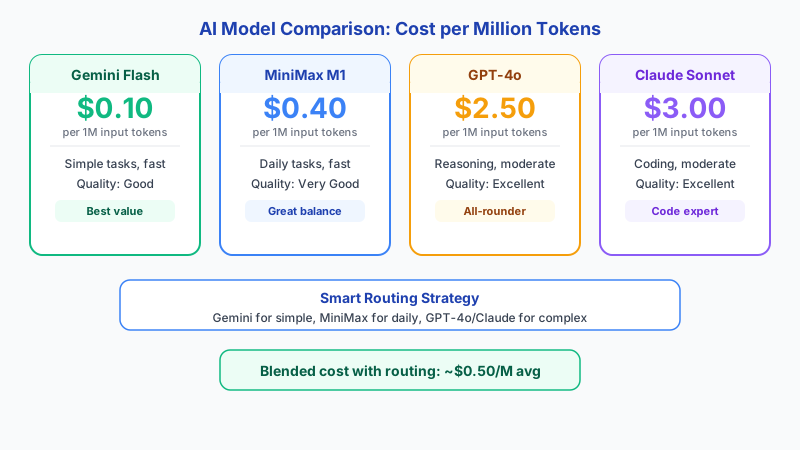
1. Model Comparison Table: Price, Speed, and Quality
Here are the models worth considering for OpenClaw in 2026, ranked by cost per million input tokens. All prices are from OpenRouter as of early 2026 and can change, but the relative tiers stay consistent.
OpenRouter hosts 29+ free models. The free tier provides 20 requests per minute without credits. Append :free to any model ID (for example, meta-llama/llama-3.3-70b:free) to use it at zero cost. Top free models worth trying: Llama 3.3 70B for general tasks, DeepSeek R1 for reasoning, Gemini Flash Exp with its massive 1M token context, Qwen3 Coder 480B for coding, and Gemma 3 27B for multimodal vision tasks.
Benchmark context: DeepSeek V3 scores 88.5% on MMLU versus GPT-4o at 87.2%. DeepSeek R1 hits 96.1% on HumanEval for code generation. Context window sizes vary enormously: Llama 4 Scout supports 10M tokens, Gemini 2.5 Pro handles 2M tokens, Claude offers 200K, and GPT-4o provides 128K.
Model Comparison (via OpenRouter, early 2026):
┌──────────────────────────────┬──────────┬──────────┬────────────┬──────────┐
│ Model                        │ Input/M  │ Output/M │ Context    │ Best For │
├──────────────────────────────┼──────────┼──────────┼────────────┼──────────┤
│ Gemini 2.0 Flash             │ $0.10    │ $0.40    │ 1M tokens  │ Daily chat, triage     │
│ MiniMax M1                   │ $0.40    │ $1.10    │ 1M tokens  │ Long-context tasks     │
│ Llama 3.1 8B (local/Ollama)  │ FREE     │ FREE     │ 128K       │ Privacy, offline       │
│ DeepSeek V3                  │ $0.27    │ $1.10    │ 128K       │ Coding, reasoning      │
│ Claude 3.5 Sonnet            │ $3.00    │ $15.00   │ 200K       │ Complex reasoning      │
│ GPT-4o                       │ $2.50    │ $10.00   │ 128K       │ General premium        │
│ Claude Sonnet 4              │ $3.00    │ $15.00   │ 200K       │ Coding, analysis       │
└──────────────────────────────┴──────────┴──────────┴────────────┴──────────┘

Free tier options:
- Gemini 2.0 Flash: 15 RPM free via Google AI Studio (no OpenRouter needed)
- Llama 3.1 8B: completely free when run locally via Ollama
- DeepSeek V3: often has free promotional tiers on OpenRouter
2. Recommended Configurations by Use Case
For daily chat and general assistant tasks, use Gemini 2.0 Flash. At $0.10 per million input tokens, you can send hundreds of messages per day for pennies. It handles summarization, Q&A, drafting, and light planning well. Set it as your primary model.
For coding tasks, use DeepSeek V3 or Claude Sonnet. DeepSeek V3 is strong at code generation and costs a fraction of Claude. Use Claude Sonnet as a secondary model for complex multi-file refactors or architecture decisions where getting it right the first time saves debugging hours.
For privacy-sensitive work, run Llama 3.1 8B locally through Ollama. Nothing leaves your machine. Ideal for processing personal documents, journal entries, or internal company data you cannot send to external APIs.
// Budget setup: ~$2-5/month for moderate daily use
{
  "models": {
    "providers": {
      "openrouter": {
        "api": "openai-completions",
        "baseUrl": "https://openrouter.ai/api/v1"
      }
    }
  },
  "agents": {
    "defaults": {
      "model": {
        "primary": "openrouter/google/gemini-2.0-flash-001"
      }
    }
  }
}
// Coding-focused setup: cheap default + premium fallback
{
"agents": {
"defaults": {
"model": {
"primary": "openrouter/deepseek/deepseek-chat-v3-0324",
"secondary": "openrouter/anthropic/claude-sonnet-4"
}
}
}
}// Privacy setup: all local, zero API cost
{
"models": {
"providers": {
"ollama": {
"api": "openai-completions",
"baseUrl": "http://host.docker.internal:11434/v1"
}
}
},
"agents": {
"defaults": {
"model": {
"primary": "ollama/llama3.1:8b"
}
}
}
}All of this for $29/mo, unlimited usage
No per-message limits, no token quotas, no surprise charges. Your dedicated OpenClaw agent runs 24/7 at full speed.
Start Free Trial3. Cost Math: What 10,000 Messages Actually Costs
A typical OpenClaw message averages 500 input tokens (your prompt plus injected memory context) and 300 output tokens (the response). With 10,000 messages per month, that is 5 million input tokens and 3 million output tokens.
With Gemini 2.0 Flash: (5 x $0.10) + (3 x $0.40) = $1.70/month. With MiniMax M1: (5 x $0.40) + (3 x $1.10) = $5.30/month. With Claude Sonnet: (5 x $3.00) + (3 x $15.00) = $60.00/month. The price difference between budget and premium models is 35x for the same volume.
Most users send 500-2,000 messages per month. At that volume, Gemini Flash costs under $0.35/month in API fees. Even heavy users rarely exceed $5/month with a budget model.
4. How to Switch Models Without Downtime
Changing your model in OpenClaw takes one config edit and a container restart. Your memory, skills, and channel connections are unaffected. To test a new model before committing, use the secondary model slot and route specific tasks to it.
Monitor the first 50 responses after switching. Look for: instruction-following accuracy, response length consistency, and whether tool-calling still works. Budget models sometimes struggle with structured JSON output or multi-step tool chains.
# Update model in running container
docker exec openclaw-agent cat /home/node/.openclaw/openclaw.json
# Edit the "primary" field, then restart:
docker restart openclaw-agent

# Watch logs for errors after model change
docker logs openclaw-agent --tail 20 -f
5. When Free Models Are Not Enough
Free and cheap models fail at three specific tasks: long multi-step reasoning chains (planning a 10-step project), nuanced tone matching (writing in a specific voice), and complex code refactoring across multiple files. If your workflows hit these limits, use a tiered approach: cheap model as default, premium model triggered by specific skill commands or keywords.
The sweet spot for most users is Gemini Flash as primary (handles 90% of requests) with Claude Sonnet as secondary (handles the 10% that need quality). This keeps monthly API costs under $5 while still delivering premium results when they matter.
Conclusion
The cheapest OpenClaw setup uses Gemini 2.0 Flash at $0.10/M input tokens for daily tasks and Llama 3.1 8B locally for privacy-sensitive work. Add a premium model like Claude Sonnet as a secondary only for tasks where quality directly impacts outcomes. At typical usage, expect $1-5/month in API costs with this approach.
Skip the setup? DoneClaw deploys OpenClaw for you — $29/mo with 7-day free trial, zero configuration.
All of this for $29/mo, unlimited usage
No per-message limits, no token quotas, no surprise charges. Your dedicated OpenClaw agent runs 24/7 at full speed.
Start Free TrialFrequently asked questions
What is the single cheapest model that still works well?
Gemini 2.0 Flash at $0.10 per million input tokens. It handles daily chat, summarization, and triage reliably. For zero cost, run Llama 3.1 8B locally via Ollama.
Can I use multiple models at the same time?
Yes. Set a cheap model as primary and a premium model as secondary in your OpenClaw config. The primary handles all requests by default. Skills or specific workflows can be configured to use the secondary model.
How often do model prices change?
OpenRouter prices update frequently as providers adjust. Gemini Flash and DeepSeek V3 have been stable for months. Check openrouter.ai/models for current pricing before making a decision.